Tenebris Somnia developer: Team Behind the Horror
Who the Tenebris Somnia developer team is, plus release platforms, cast, and the film-style horror design.
A survival-horror credit crawl rarely doubles as a film set call sheet. If you looked up the Tenebris Somnia developer, you are really asking who decided chunky pixels and live-action nightmares belong in the same scene. That answer matters on October 17, 2026, one day after launch, because the Tenebris Somnia developer group is a Buenos Aires mix of game makers and award-winning filmmakers, not a nameless port studio.
New Blood Interactive put the game on Nintendo Switch, Nintendo Switch 2, PlayStation 5, Windows, and Xbox Series X/S on October 16, 2026. The interesting part is not the platform list. It is how a film-trained director and a retro-horror publisher tried to make two visual languages feel like one nightmare.
Who the credits actually name
Published credits and a stage interview do not always use the same words. Treat them as two layers. The reference page for the game lists Andrés Borghi and Saibot Studios as developers. It also describes the project as co-created by Borghi and Tobías Rusjan, in association with Saibot Studios, and developed in Argentina. New Blood Interactive is the publisher, not the day-to-day developer.
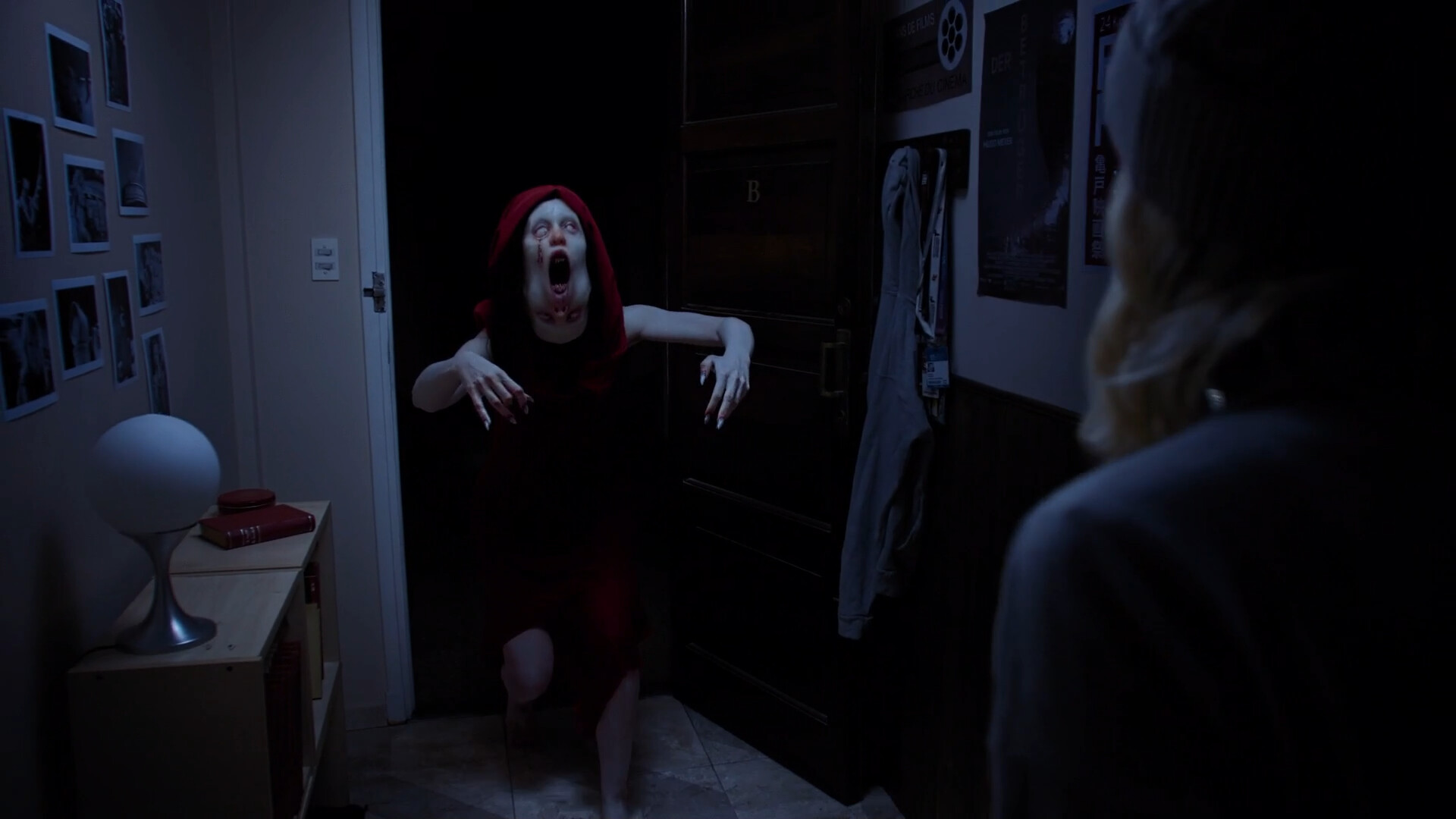
Official screenshot · Source: Steam store
In the PC Gaming Show Tokyo Direct 2026 segment, collaborators talk about Andrés as the game director and as a director of horror short films. They single out a strong visual plan and a sharp eye for detail. An executive producer on that stage introduces himself as someone who makes scary games and who holds that producer role on this project. The auto-generated transcript garbles his first name, so it should not be copied into a credit block. When you need a name you can stand behind, use Borghi, Rusjan, and Saibot Studios.
Argentine press context matters here, and it should stay narrow. A September 2024 Clarín article, cited from the game's reference page, frames this as an '80s-style game tied to the person behind the special effects on When Evil Lurks (Cuando acecha la maldad). That is a pedigree claim about practical creatures, not a full filmography. The showcase itself calls the crew an award-winning visual-effects and monster-effects team. It describes real practical creature work, very little digital cleanup, and old-fashioned movie trickery. Dozens of people and hundreds of hours is the only scale figure the segment offers. Treat it as the team's own description, not an audited headcount.
| Credit | What the sources support | What they do not support |
|---|---|---|
| Andrés Borghi | Listed developer and co-creator; called game director; horror short-film director | A complete list of every prior film credit |
| Tobías Rusjan | Named co-creator with Borghi | A public job title beyond co-creator |
| Saibot Studios | Listed developer, associated with the Argentine production | Other studio titles not mentioned in these sources |
| Executive producer (showcase) | A scary-game developer who produced this project | A reliable spelling of the spoken first name |
| New Blood Interactive | Publisher; presents the game beside its retro catalog | Day-to-day development in place of the Argentine team |
Cast that has to sell a silent nightmare
The story follows Julia, a woman hemmed in by evil nightmares. She goes to see an ex-boyfriend, does not find him, and slips into a parallel world where monsters hunt her. The principal cast attached to that story is short, which fits a piece built on faces more than speeches.
| Performer | Role in the published cast |
|---|---|
| Clara Kovacic | Julia |
| Pedro Merlo | Ivan |
| Maria Eugenia Rigon | Vitra |
| Esteban Prol | Sanguis |
| Yael Tesouro | A disfigured woman |
Showcase commentary lingers on Kovacic. There is no dialogue in the cutscenes. The performance is compared to a silent film: expression, emotion, and feeling carry the scene. The stated goal is that the story still feels natural no matter which language you play in. That is a developer choice with a practical result. Localization can translate menus and item text without dubbing a speech that was never written.
Film craft inside a pixel game
Tenebris Somnia is a 2D retro pixel horror game with live-action cutscenes baked into a full survival-horror structure. The showcase claim is not "a game with a trailer stapled on." Speakers describe a relationship between filmed scenes and play that feels nearly seamless, even though the two styles could not look more different.
That seam is also a trap. You are told to stay ready, because a cutscene can end and drop you into a dangerous situation. The artistic pitch is that you are playing through someone's nightmares. The design pitch is harsher: the film does not grant you a safe lobby.
The nightmare is not random monster wallpaper. Speakers say the team is interested in troubled relationships, and that people who have lived through one will find something to recognize. Puzzles are praised for being tied to that same world. They reflect a sick mirror of the characters' lives before the game began. If a lock or a ritual feels symbolic, that is the point the developers say they were aiming at, not a stretch you invented after the credits.
The production argument is blunt. The team says this mix took dozens of people and hundreds of hours, and that generative tools could not have produced Tenebris Somnia. Read that as a craft stance from the showcase, not a lab result. What you can check with your own eyes is the method they describe: practical monsters, limited digital manipulation, and staged "movie magic," then a hard cut back into scarce ammo and a pipe.
| Layer | What you see | What the team says it is for |
|---|---|---|
| Pixel gameplay | Retro 2D survival horror | The actual game, not a bridge between films |
| Live-action scenes | Silent, performance-led footage | Emotion that does not depend on spoken language |
| Practical creatures | Filmed monster effects with little digital polish | A handmade look the team says tools could not fake |
| Thematic puzzles | Obstacles wired to the nightmare | A mirror of life before the story started |
| Resource pressure | Thin health, thin ammo, frequent melee | Classic survival-horror stress, on purpose |
Publisher, date, and platforms
New Blood's role is the other half of the search. On the Tokyo Direct stage, the publisher framed itself through a catalog players already argue about: Dusk, Amid Evil, Ultrakill, Faith: The Unholy Trinity, Gloomwood, Fallen Aces, Blood West, and now this game. The joking follow-up was that people would finish a session, admit the game itself is strong, and then hear, essentially, that this is what a New Blood release is supposed to feel like. That line is marketing, but it is useful. It tells you the publisher wants gameplay judged beside the cutscenes, not behind them.
The creator of Faith: The Unholy Trinity, speaking in the same showcase, offered a playful dare: play this and consider some tongue-in-cheek absolution, with no guarantees. The sign-off was the whole pitch in miniature. Retro horror, real nightmares, try it.
You can watch the claims in context in the PC Gaming Show Tokyo Direct 2026 interview. Use it for tone and intent. Use the published credits when you need names.
| Platform | Release | Mode and genre |
|---|---|---|
| Windows | October 16, 2026 | Single-player survival horror |
| PlayStation 5 | October 16, 2026 | Single-player survival horror |
| Xbox Series X/S | October 16, 2026 | Single-player survival horror |
| Nintendo Switch | October 16, 2026 | Single-player survival horror |
| Nintendo Switch 2 | October 16, 2026 | Single-player survival horror |
A same-day list that wide is a publisher story as much as a developer story. The Argentine team built a 2D game with filmed inserts. New Blood is the reason that package is a multiplatform launch instead of a single-store curiosity. If you are writing a patch note, a review, or a wiki line, put development with Borghi, Rusjan, and Saibot Studios, and put publishing with New Blood. Swapping those roles is the fastest way to get the credit wrong.
Design habits worth using on night one
The showcase is not a strategy guide, but it is specific enough to change how you play the first hour. These are habits drawn from what the team said it built, not from a completed community tier list. As of October 17, 2026, broad player-experience writeups are still thin because the game has only just shipped. Label later ammo routes and puzzle charts as player experience once multiple people confirm them. Do not treat a single stream as a map.
| Habit | Why the developers pointed you there | What to do in the first session |
|---|---|---|
| Assume the cutscene ends hot | Play can resume inside a threat | Keep your hands ready; do not treat film as a pause menu |
| Spend bullets last | You only ever have just enough ammo | Try the wrench or the pipe before you empty a gun |
| Expect thin healing | You only ever have just enough health | Retreat early; a "fair" stock of medkits is not the fantasy |
| Solve for theme | Puzzles mirror the pre-game lives of the characters | Ask what the nightmare is distorting, not only which key fits |
| Watch faces, not subtitles | Julia's filmed scenes have no dialogue | Read fear and recognition before you hunt for a spoken clue |
| Judge the systems | Speakers expect praise for play, not only for film | Give combat and inventory a real hour before you score the game |
A few extra checks keep the retro framing honest.
- Survival-horror staples are intentional. If the inventory feels strict and the spaces feel mean, that matches the stated design, not a missing easy mode you failed to find in the first ten minutes.
- Melee is a plan, not a failure state. A pipe or a wrench is how the team expects many fights to end.
- Relationship context is load-bearing. Ivan is in the cast, Julia is looking for an ex who is not there, and the showcase keeps returning to troubled relationships. Skipping the quiet scenes will make the puzzles feel arbitrary.
- Language settings will not "fix" the cutscenes by adding speech that was never recorded. The silence is the performance.
- The retro look was called a real design challenge, not a filter. Low-resolution space still has to teach threats, puzzles, and exits. If a silhouette reads badly, that is worth a settings check for brightness before you blame the art direction.
None of this requires leaked stats. "Just enough health" and "just enough ammo" are design sentences. They tell you the intended pressure. They do not tell you the exact magazine size on the third weapon, and this article will not invent one.
How to talk about the team without spreading bad credits
People searching for the developer usually need a sentence they can paste. Use this shape: Tenebris Somnia was co-created by Andrés Borghi and Tobías Rusjan with Saibot Studios, developed in Argentina, and published by New Blood Interactive for a multiplatform launch on October 16, 2026. Borghi is also described as game director and as a horror-short director. The filmed monsters are presented as practical work with limited digital manipulation.
Add showcase color only after that sentence. The game is 2D pixel survival horror with live-action inserts, silent lead performance, scarce resources, and puzzles aimed at a nightmare version of the characters' earlier lives. If you mention awards, attribute them. Say the Tokyo Direct segment called the filmmakers and the effects team award-winning. Do not upgrade that into a list of trophies the sources never name.
Avoid three common slips.
- Do not rename the game "Tenebrous Somnia." That wording shows up in rough transcripts because it sounds like the Latin title. The published name is Tenebris Somnia.
- Do not promote the publisher into the developer slot, or the studio into the publisher slot.
- Do not turn a garbled spoken intro into a new credited founder. If a name is only clear in an auto-caption, wait for a printed credit.
For players deciding whether to buy, the same discipline helps. The team is selling a specific promise: a New Blood survival-horror game whose film scenes and whose wrench-and-ammo tension are part of one nightmare. If you want a dialogue-heavy drama, the silent cutscenes will fight you. If you want a boomer shooter from the rest of that catalog, the scarcity will fight you. If you want retro horror that takes relationships and practical monsters seriously, the Tenebris Somnia developer pitch lines up with the product they described on stage.
One last distinction keeps coverage fair the week after launch. Developer intent and player experience are not the same report. Intent, right now, is well documented: seamless style shifts, dangerous scene exits, silent acting, thin supplies, thematic puzzles, Argentine film craft, New Blood distribution. Experience will be whatever runs, difficulty spikes, and puzzle fairness players actually find. When those reports show up, label them as player experience or community reports, and keep them separate from the credit block.
FAQ
Who is the Tenebris Somnia developer?
Andrés Borghi and Saibot Studios are the listed developers. Borghi co-created the game with Tobías Rusjan, in association with that studio, and the work was developed in Argentina. Showcase comments also describe Borghi as game director. New Blood Interactive publishes the game. It does not replace those development credits.
When did the game release, and on what platforms?
It launched on October 16, 2026, for Nintendo Switch, Nintendo Switch 2, PlayStation 5, Windows, and Xbox Series X/S. It is a single-player survival horror game. The article date is the day after that launch, so long-term player-experience consensus is not available yet.
Is it mostly cutscenes, or a full game?
The team describes a full survival-horror game with live-action scenes built in, not a film that occasionally lets you walk. They point to classic staples: tight health, tight ammo, frequent melee, and puzzles tied to the story. Speakers even predicted that players would be surprised the systems hold up once the novelty of the footage wears off.
Why does Julia barely seem to talk on screen?
Because the cutscenes were built that way. Clara Kovacic's performance as Julia is highlighted for having no dialogue, closer to a silent film than to a voiced cinematic. The aim is that emotion still reads cleanly no matter which language you play in. Menus may localize. The filmed silence is part of the performance, not a missing audio track.
Related Guides
Tenebris Somnia ai: Developer Facts and Release
Facts on Tenebris Somnia ai: developers, October 16, 2026 release, cast, platforms, and how to spot unsupported AI claims.
Tenebris Somnia developer interview Highlights
What the Tenebris Somnia developer interview reveals about live-action horror, scarce ammo, and a story that hits too close to home.
Tenebris Somnia engine: How Unreal Builds Horror
Learn how the Tenebris Somnia engine pairs Unreal Blueprints with retro 2D horror and filmed cutscenes, plus specs and practical dev tips.
Tenebris Somnia demo walkthrough: every puzzle step
Tenebris Somnia demo walkthrough for the free Steam and Xbox slice: chemical door, wrench fights, and the shifting apartment.
Tenebris Somnia Demo Guide: Platforms and Story
Learn what the Tenebris Somnia demo includes on Xbox and PC, from platforms and age rating to a practical first-session plan.