Tenebris Somnia developer interview Highlights
What the Tenebris Somnia developer interview reveals about live-action horror, scarce ammo, and a story that hits too close to home.
Horror marketing loves a gimmick, but the Tenebris Somnia developer interview argues this one is the whole game. That conversation matters if you care whether live-action cutscenes can live inside tight 2D survival systems without becoming a tech demo. The Tenebris Somnia developer interview, recorded for the PC Gaming Show Tokyo Direct 2026, is the best public explanation of how an Argentine film crew, a wrench, and a bad relationship share one nightmare.
New Blood Interactive is publishing the game, and CEO Dave Oshry carries much of the minidoc that PC Gamer's coverage of the Tokyo Direct segment recaps. Executive producer Airdorf supplies the mood. Together they describe retro 2D survival horror that cuts, at key beats, to scenes shot with real actors and practical makeup. The date attached to that pitch is October 16, 2026, set just before Halloween.
The coverage reads less like a feature list and more like a dare. The images should scare you, the inventory should starve you, and the plot should feel familiar if you have ever stayed too long in a relationship that was already over.
What the minidoc is actually promising
Reading the Tenebris Somnia developer interview as a design document, not a trailer voiceover, makes the pitch easier to test. Three promises repeat. Camera language jumps from colorful, uneasy 2D corridors to a filmed human face that warps in ways a sprite sheet usually fakes. The survival layer refuses comfort: health and ammunition stay at the edge of enough, and a blunt tool is a normal weapon, not a punch line. The story aims at people who recognize a troubled relationship, not only people collecting monster designs.
Official screenshot · Source: Steam store
That is narrower than "retro horror with cool cutscenes." It tells you what to judge when you play, or when you rewatch the Tokyo Direct segment before you spend money. If the filmed scenes feel like unrelated shorts, the first promise failed. If you leave an area with a fat ammo stock and a full heal, the second promise failed. If the plot is a generic haunting with a relationship sticker on the box, the third promise failed.
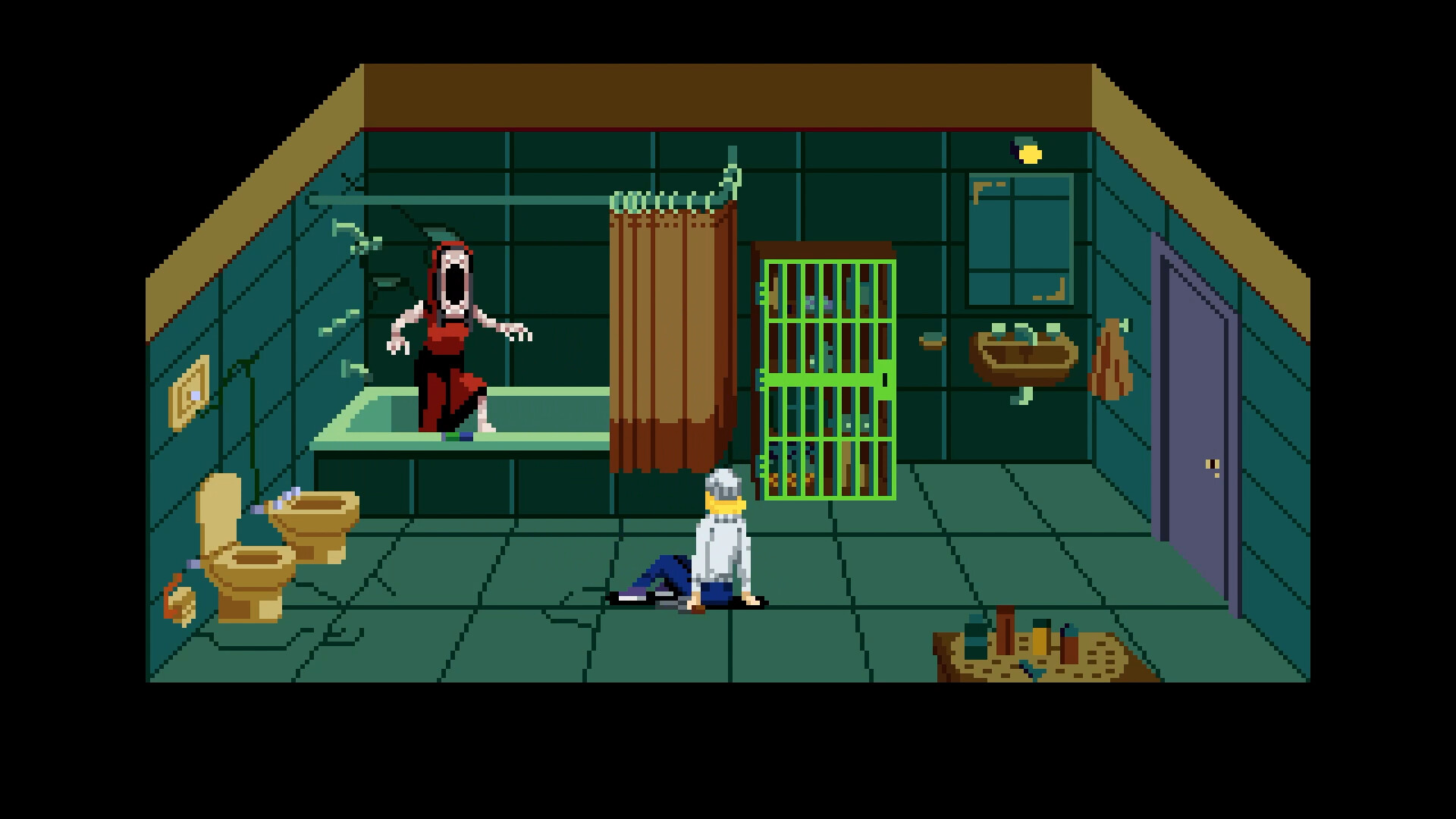
The write-up by Issy van der Velde is useful because it gets specific. One creature carries a second face under the first, and the two meet at a single mouth. The image paired with that description places the encounter in a bathroom. Those details beat vague praise. They show body horror you can retell, not a blur of teeth and lighting.
| Promise from the interview | What coverage actually shows | How you can check it |
|---|---|---|
| Retro 2D space, then a real performance | Creepy colorful halls cut to a filmed, distorting face | Watch one transition and see if tension carries |
| Survival pressure, not a power fantasy | Health and ammo described as barely sufficient; wrench or pipe as common tools | After one fight, note whether you shot or swung |
| A damaged relationship, not only lore | Framed as funny, sad, and personal enough to remind you of an ex | Listen for people, not a bestiary |
| Craft over generation | Practical materials and an Argentine crew; a hard no to AI making this game | Look for skin, light, and makeup edges in filmed shots |
Why the filmed scenes are the point
Companion coverage describes the playable half in plain verbs. You uncover a disturbing story by solving puzzles, searching unsettling rooms, and fighting horrible creatures. The same report says the darkest secrets are not in those rooms. They sit in filmed sequences. Control drops away and a crew takes over: actors, practical effects, and a film team from Argentina that the publisher treats as a selling point.
Oshry talks that crew up. The recap's tone is half joke and half review: the makeup is convincing enough that hiring demons sounds simpler than building prosthetics. Airdorf's line matches that flinch. He describes the feeling as moving through someone else's nightmares. Nightmare logic is what a hard cut can sell. One moment you are in a side-view hallway. The next you are looking at ruined skin the way a film looks at it. You do not ease into the monster.
Practical work versus a generated shortcut
The most quoted stance is easy to flatten into a slogan. Oshry's point is a production claim: this horror image depends on materials you can touch. He puts it bluntly enough that the headline version is "AI could never make this." Practical makeup catches light wrong on purpose. Seams, moisture, and a mouth joining two faces are physical problems. Generated footage often smooths those problems away, or it invents anatomy that looks expensive and weightless at once. The segment picks a side in a 2026 argument without becoming a lecture. If you can tell a computer averaged the face, the scare fails.
That choice is expensive for a 2D game, which is why it is interesting. Pixel spaces are cheap to revise. A film day is not. Tying reveals to a camera crew means those beats were planned early, shot with limited takes, and cut into a game that still needs exploration. A multi-year festival run makes that schedule look deliberate, not like a trailer bolted on in the last month.
| Moment | Who has control | What the interview wants you to feel |
|---|---|---|
| 2D exploration | You, moving through uneasy rooms | Dread from color and layout, not only darkness |
| Puzzles | You, reading the space | Slower fear that lets the story sink in |
| Creature fights | You, with thin resources | Panic, because a gun is not the default |
| Filmed insert | The camera and the actors | Shock, intimacy, and nightmare logic |
Health, ammo, and the wrench
The scarcity lines in the Tenebris Somnia developer interview are the clearest gameplay notes available, and they are worth taking literally. Oshry says health never rises above just enough, ammunition is just as tight, and you will often resort to a wrench or a pipe. He is holding a wrench while he says it. The prop is explanatory. Melee is not a shame state. It is the weapon he wants stuck in your memory.
Survival horror already trained players to hoard. You skip shots so a later threat does not empty the box. If this game means what he says, hoarding still matters, but the floor is lower. "Just enough" is not "a little extra if you search every drawer." It behaves like a ceiling. Spare health on the floor would break the sentence. A room that refills the magazine because you were clever would break it too, unless that refill is the whole reward and the next room spends it.
What barely enough changes in play
The interview never publishes damage numbers or inventory caps. A few expectations still follow from the wording.
- Healing is probably rare enough that a hit is a chapter-level decision, not a shrug.
- Ammunition is special. Spraying a corridor means you meet the next threat with metal in your hands.
- The wrench and the pipe need to be viable. If melee is a panic button that gets you killed, the quote was marketing. If it is slow, risky, and sometimes correct, the quote was design.
- Exploration should feed the story and the next inch of health, not a shopping spree.
Nothing in the Tenebris Somnia developer interview spells out chapter length, enemy counts, or whether the pipe and the wrench are separate tools. Leave those open. What you can score now is tone. A publisher who mimes the melee weapon while describing ammo is warning you which reviews will miss the point: the ones that call the game clunky because a shotgun fantasy never shows up.
| Resource | Interview stance | Habit it punishes | Habit it rewards |
|---|---|---|---|
| Health | Only just enough | Trading hits to move faster | Spacing, avoidance, leaving while you can |
| Ammo | Only just enough | Using guns as your main language | Saving shots for problems melee cannot solve |
| Wrench or pipe | Often the real answer | Waiting on a firearm drop | Learning range, timing, and when to back off |
| Information | Story and layout are the edge | Rushing filmed beats | Searching before you spend a bullet |
The scare that might outlast the monster
Body horror is the image. The relationship is the claim that might linger. Oshry describes a story anyone from a troubled relationship can recognize. His emotional range is blunt: you may laugh, you may cry, and you may want to call an ex. The recap treats that last beat as the scariest line in the segment. That is a useful warning. This is not tasteful melancholy parked behind a monster hunt. It is pitched as an aftereffect.
Airdorf's nightmare comparison fits. Nightmares reuse people you already know. They put a familiar voice in the wrong mouth, which rhymes, uncomfortably, with a creature whose second face is attached at the mouth. The interview never diagrams the bathroom monster as a metaphor, so do not treat that link as confirmed lore. It does put domestic pain and impossible anatomy in the same pitch. Horror lands when those tracks share a rhythm.
If you are deciding whether to play, the content shape matters more than the pixel count. Expect filmed faces, practical distortion, and a plot that wants access to your romantic history. That is a smaller audience than "people who like indie horror," and the conversation is honest about it. Comedy is part of the promise. Laughter here usually means recognition, the awful kind, not a joke every minute. If the game cannot earn that laugh, the ex line will feel like a poster. If it can, the wrench fights will be the part you forget first.
A long showcase trail
Awards listed alongside the Tenebris Somnia developer interview are easy to skim and worth putting on a calendar. Reporting next to the new gameplay credits a Best Game win at EVA 2023, a win at Unreal Argentina 2024, official selection at the Latin American Games Showcase in 2024, 2025, and 2026, and official selection at Day of the Devs 2026. That is a public life of at least three years before the October 16, 2026 date used in the Tokyo Direct push.
Festival selections are not reviews. They do not tell you the wrench feels good. They do tell you the project was finished enough, often enough, to be judged by people who see hundreds of indie builds. A 2023 prize and a 2026 store date also fit a hybrid production. Film crews and practical suits do not appear during a six-week crunch. Confidence about makeup reads differently once you notice Latin American showcase slots across three cycles, plus a Day of the Devs berth in the launch year.
| Year | Recognition named in coverage | What it suggests |
|---|---|---|
| 2023 | Best Game winner at EVA | An early build already stood out in a judged setting |
| 2024 | Unreal Argentina win; Latin American Games Showcase selection | The project stayed public after the first prize |
| 2025 | Latin American Games Showcase selection again | Not a one-festival flash |
| 2026 | Showcase selection, Day of the Devs, Tokyo Direct interview | Launch-year visibility on indie and press stages |
Separate applause from design. The trophy row supports "this team can finish unusual work." The minidoc supports "this is the unusual work." You still decide whether thin ammo and a filmed face are the night you want, especially with a release planted on October 16 so the Halloween crowd is already in a horror mood.
How to rewatch it before you buy
If you rewatch the Tenebris Somnia developer interview, do it once for scares and a second time for verbs. The first pass is what the team wants: flinch at the makeup, feel the nightmare line, remember the personal jab. The second pass keeps you from buying a vibe and receiving a different game.
A second-pass checklist
- Pause on the cut from 2D to film. Ask whether you know where the character is when the footage starts. If the interview never makes that link, look for it in gameplay clips before you assume the game does.
- Count shooting versus swinging. The energy of the combat talk is swing-first.
- Note the job titles. Oshry is the publisher's CEO. Airdorf is the executive producer. Enthusiasm and authorship are related, but they are not the same job. Listen for what each person actually claims.
- Retell one creature in plain words, such as the doubled face joined at the mouth. If you can only say "insane," the footage may be loud rather than designed.
- Check the store page yourself for the October 16, 2026 date, the price, and any feature notes. Interview coverage is not a patch note.
Taken together, the Tenebris Somnia developer interview is less a hype reel than a constraint list. Use film where it hurts. Starve the gun. Let the relationship be the line people quote later. That is enough to know whether you are the audience, which is the only verdict a preview conversation can honestly deliver.
FAQ
Where can I watch the Tenebris Somnia developer interview?
The segment press covered is the PC Gaming Show Tokyo Direct 2026 minidoc. PC Gamer's September 20, 2026 article is the most detailed written recap, and a same-day gameplay post pointed at the interview beside new footage. Watch the show video first, then use the articles to catch lines you missed.
When was Tenebris Somnia supposed to release?
Coverage tied to the interview gives October 16, 2026, timed for the run-up to Halloween. Confirm that date on the Steam page players were told to wishlist, because showcase dates and storefront dates can drift.
Did the team say AI made the cutscenes?
No. The publisher's line runs the other direction. This game, especially the practical footage, is presented as work generative tools do not produce. The crew from Argentina, real actors, and physical effects are the method the interview keeps naming.
Is the story only monster horror?
Creatures are part of the pitch, including the two-faced threat shown in a bathroom. Next to them, the story on offer is a troubled relationship, with a tone meant to be funny, painful, and personal. If that theme sounds exhausting rather than interesting, the interview has already told you to skip it.
Related Guides
Tenebris Somnia ai: Developer Facts and Release
Facts on Tenebris Somnia ai: developers, October 16, 2026 release, cast, platforms, and how to spot unsupported AI claims.
Tenebris Somnia developer: Team Behind the Horror
Who the Tenebris Somnia developer team is, plus release platforms, cast, and the film-style horror design.
Tenebris Somnia engine: How Unreal Builds Horror
Learn how the Tenebris Somnia engine pairs Unreal Blueprints with retro 2D horror and filmed cutscenes, plus specs and practical dev tips.
Tenebris Somnia demo walkthrough: every puzzle step
Tenebris Somnia demo walkthrough for the free Steam and Xbox slice: chemical door, wrench fights, and the shifting apartment.
Tenebris Somnia Demo Guide: Platforms and Story
Learn what the Tenebris Somnia demo includes on Xbox and PC, from platforms and age rating to a practical first-session plan.