Tenebris Somnia cutscenes: Practical Horror Breakdown
How Tenebris Somnia cutscenes mix retro 2D survival horror with filmed practical effects, and what the Tokyo Direct footage shows.
Tenebris Somnia cutscenes are the reason this retro survival horror is already hard to shake. Most 2D horror keeps its monsters inside sprites and sound cues, which your brain can file as "just a game." Tenebris Somnia cutscenes refuse that safety net. They drop filmed actors and physical makeup into colorful, cramped pixel spaces, and the switch is abrupt enough that coverage of the PC Gaming Show Tokyo Direct 2026 minidoc described watching with a hand over the eyes.
That contrast is the whole pitch. Publisher New Blood Interactive and executive producer Airdorf have framed the project as nightmare logic you play through, not a pixel homage with a movie bolted on. If you are deciding whether the live-action footage is a gimmick or the point, the September 2026 reporting is the clearest public evidence so far.
Why Filmed Inserts Change Retro Horror
Retro survival horror usually honors one visual contract. You explore a corridor, manage a tiny inventory, and accept that the threat is an arrangement of pixels. That contract is comforting even when the game is mean. A real face, lit like a film and bent by makeup, cancels the comfort. Skin texture, eye moisture, and a prosthetic edge catching a practical light are signals we associate with movies. Once those signals appear, the pixel hallway you were just walking stops feeling like a toy.
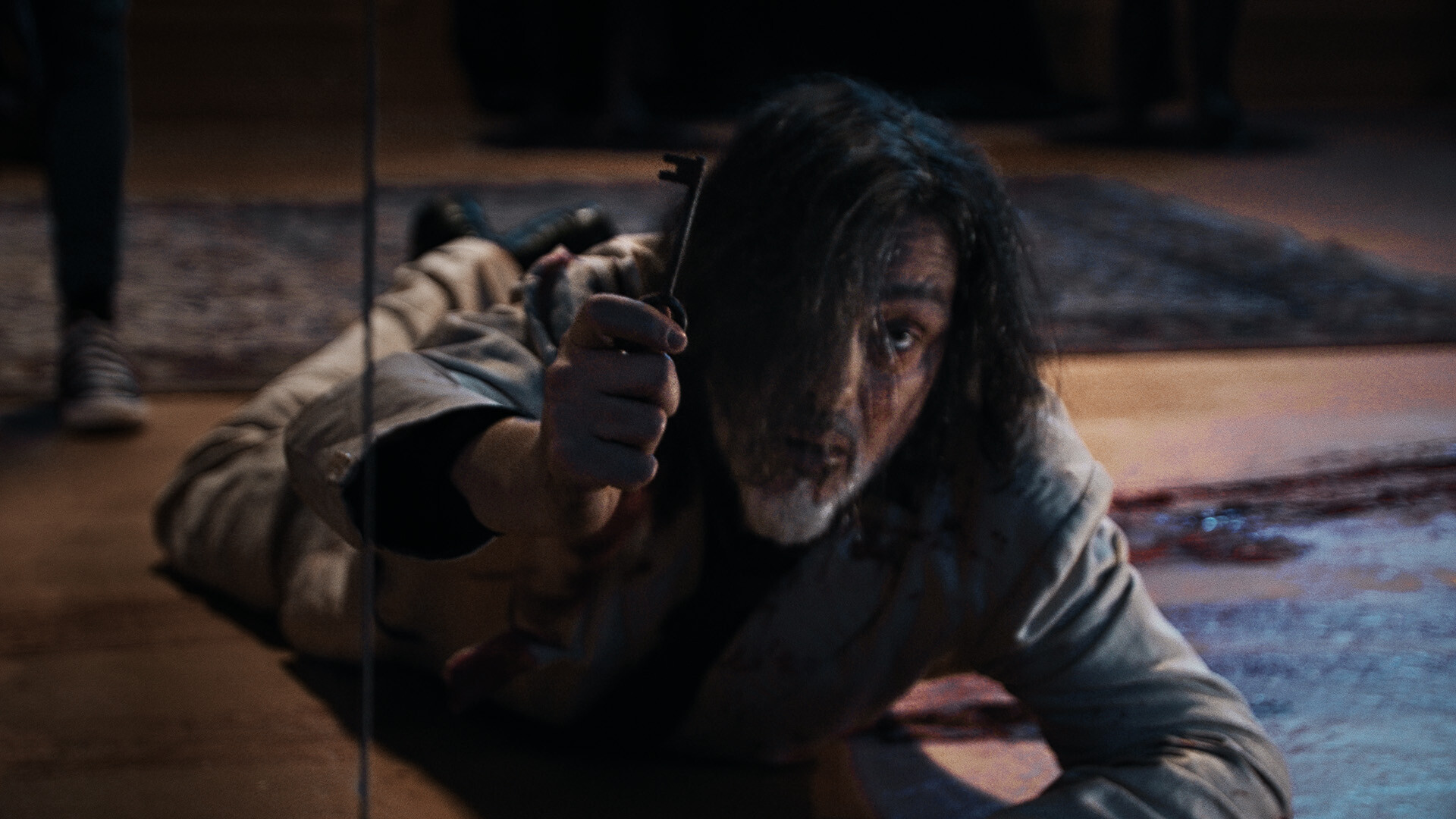
Official screenshot · Source: Steam store
The public footage leans on that whiplash. One moment is a creepy, colorful 2D passage. The next is a person's face distorting past any believable anatomy. Coverage also describes a bathroom encounter with a two-faced woman: an extra face under the first, joined through a single mouth. That image is not a vague "monster design." It is a specific body-horror idea, built so you can see the seam between faces. Executive producer Airdorf has said the game feels like moving through someone's nightmares. The filmed shots are how that claim becomes physical instead of rhetorical.
| Layer | What the footage emphasizes | What it does to the player |
|---|---|---|
| Retro 2D exploration | Colorful, uneasy hallways and room-to-room survival | Keeps the familiar indie-horror grammar |
| Live-action inserts | Real performers, practical makeup, impossible facial distortion | Breaks the "it's only pixels" defense |
| Scarce survival tools | Barely enough health and ammo, frequent wrench or pipe | Makes the stretches between films feel desperate |
| Relationship framing | A story aimed at people who have lived through a bad bond | Adds embarrassment and grief beside the creatures |
Search interest in the filmed scenes makes sense. People want to know whether the movie portions carry the scares or merely advertise them. Based on how both the publisher and the press lead with the Argentine film crew, the inserts are identity, not garnish. The 2D game still has to function as survival horror. The films are what make the nightmare feel witnessed rather than drawn.
What the Tokyo Direct Segment Actually Shows
The best pre-launch look is the developer interview packaged as a PC Gaming Show Tokyo Direct 2026 minidoc. Issy van der Velde's write-up for PC Gamer's report on the live-action survival horror is the detailed public account of that segment. It is a reaction piece from September 20, 2026, not a scored review and not a full plot synopsis. Treat it that way.
Van der Velde compares the tone to Argentine horror cinema and says the makeup was frightening enough to watch partially covered. That is a press reaction, not a community consensus. There is no broad player experience to cite yet from that article, because the piece predates wide release. Dave Oshry, CEO of New Blood Interactive, is shown talking up the practical-effects crew while holding a wrench. The image is marketing and design statement at once: this is a game where the improvised tool is part of the fantasy.
| Confirmed detail | What September 2026 coverage states |
|---|---|
| Publisher | New Blood Interactive |
| Publisher spokesperson | Dave Oshry, CEO |
| Executive producer | Airdorf |
| Filmed material | Award-winning film crew from Argentina |
| Effects bias | As many practical effects as possible; mostly physical materials |
| Showcase | PC Gaming Show Tokyo Direct 2026 developer minidoc |
| Announced release | October 16, 2026, aimed at the Halloween window |
| Storefront call to action | Wishlist on Steam, ahead of that date |
Airdorf's nightmare line is the cleanest creative summary available. Oshry's resource line is the cleanest systems summary. Together they explain the hybrid: you are not watching a short film that happens to have a game attached, and you are not playing a sprite crawler that happens to have a trailer. The minidoc sells both halves in the same breath.
What the segment does not provide, and what you should not invent while watching it:
- A complete scene list or a runtime for the filmed material
- A map, weapon list, or difficulty breakdown
- Confirmation of how often films interrupt play
- Any post-launch player experience, patch notes, or review scores
This article is dated October 17, 2026, one day after the announced release. The sourced reporting is still the September minidoc coverage. Day-one reception is outside that record, so it is not treated as fact here.
Practical Makeup Versus Generated Images
Oshry's bluntest claim was that generative tools could not have made this game. Read that as a craft argument from the publisher, not as a lab result. The supporting detail in the coverage is more useful than the slogan: the disturbing shots are mostly physical. Prosthetics, makeup, and performed distortion are why a journalist believed the faces. A generated still can imitate gore. It is worse at the small errors that make a practical creature feel present, such as a prosthetic pulling real skin, a light wrapping a real object, or an actor flinching half a second early.
The two-face gag is a good test. An extra face under another, connected at the mouth, has to occupy space. In a film frame, you can see how the lower face sits in shadow and how the mouth junction stretches. That is harder to fake convincingly with a flat composite, and it is a strange thing to ask a pixel artist to carry alone if the rest of the game is deliberately retro. The production choice is to switch mediums at the moment anatomy breaks.
| Approach | Strength in a horror beat | Weakness for this kind of shot |
|---|---|---|
| Practical makeup and props | Real light, real texture, actor timing | Cost, safety limits, fewer easy reshoots |
| Traditional digital VFX | Can extend a practical gag past what latex allows | Can look weightless if it replaces the body entirely |
| Generative imagery | Fast concept art and mood boards | Unstable anatomy and plastic skin when used as the final face |
| Retro pixel art | Readable gameplay and a strong style | Harder to sell a specific, intimate facial distortion |
Use that table as a viewing framework, not as a leaked pipeline. Coverage says "mostly" practical and "as many practical effects as possible." It does not publish a shot budget, a crew size, or a denial that any digital cleanup exists. Hybrid films almost always include some digital work. The honest claim is narrower: the images people are reacting to were built to look handmade, and the publisher wants that handmade quality to be the point.
If you are comparing trailers yourself, pause on three checks:
- Does the face keep consistent structure across the cut, or does it melt like a slideshow?
- Do shadows match the room, or does the creature look pasted on?
- Does the actor's reaction lead the effect, or does the effect lead a frozen face?
Those checks will not prove a pipeline. They will tell you whether the scare survives a second viewing, which is what matters if the films are short and meant to be remembered.
Survival Pressure Between the Films
The minidoc is not only a makeup reel. Oshry describes a stingy survival loop: health that never feels surplus, ammunition that never feels comfortable, and a frequent drop to a wrench or a pipe. He is literally holding the wrench while he says it. That is classic survival-horror pressure, closer in spirit to tight inventories and bad odds than to a power fantasy with cinematic rewards.
The design only works if the films and the scarcity talk to each other. A lavish creature scene followed by an overstocked arsenal would deflate both. A cruel resource game with dull story scenes would feel like punishment without a dream to be inside. The intended rhythm, as described, is peak and valley. The filmed distortion is the peak. The valley is a hallway where the gun is a maybe and the pipe is the plan.
| Pressure | How the publisher described it | Why it matters next to filmed scenes |
|---|---|---|
| Health | You only ever have just enough | A scare cannot be shrugged off with a huge bar |
| Ammo | You only ever have just enough | Firearms stay exceptional, not a solution |
| Melee | A wrench or pipe is a common resort | Panic stays close, personal, and clumsy |
| Story mood | Relatable to a troubled relationship | Damage is emotional as well as physical |
None of those lines are a balance sheet. "Just enough" is a promise until players can test it. When real player experience exists, the useful questions will be simple: How often does ammo actually run out? Does melee trivialize encounters? Do films gate progress or punctuate it? Until those reports exist, the minidoc is a statement of intent.
While you watch any later gameplay trailer, keep a scratch tally:
- Seconds of exploration versus seconds of filmed horror
- Times a gun is fired versus times a tool is raised
- Whether a heal or reload is shown on screen
- Whether the 2D rooms stay readable when the films end
That tally is more informative than a hype sentence. If the only combat shown is a single cinematic kill, you still do not know the survival game. If the only horror shown is a sprite in a dark corridor, you are not seeing the thing this project is selling.
Story Tone and What to Watch Before You Spoil It
The story, as Oshry frames it, is meant for anyone who has been inside a troubled relationship. His marketing line stacks laugh, cry, and the urge to contact an ex. That is a tone warning more than a plot summary. The scariest promise in the September coverage, according to the writer, may be the emotional one rather than the extra face. Creatures end when the cut ends. A story that recognizes a bad relationship can linger because it borrows from ordinary life.
Nightmare logic is the bridge. Airdorf is not describing a procedural mystery with a tidy evidence board, at least not in the quotes we have. He is describing play that feels like someone else's bad dream. Dreams reuse rooms, misread faces, and turn domestic spaces, like a bathroom, into traps. A two-faced figure in that setting fits the theme without needing a lore dump. Intimacy becomes anatomy. A person you thought you knew has another face, and both faces share a mouth.
| Image called out in coverage | Horror job it appears to do |
|---|---|
| A real face bending past anatomy | Uncanny shock that pixels would soften |
| Extra face beneath the first, joined at one mouth | Body horror with a clear, sticky visual idea |
| Bathroom meeting with the two-faced woman | Turns a private room into a nightmare set |
| Colorful 2D hallway before the film | Makes the medium switch feel like a snap |
Do not expect a scene-by-scene breakdown from responsible coverage, and do not hunt one if you want the films to work. The power of this approach depends on surprise. Knowing that practical faces exist is enough. Knowing the order of every distortion is how you sand the nightmare flat.
A practical watch plan, using only what is already public:
- Watch the Tokyo Direct developer segment once for tone, not for clues.
- On a second pass, note which shots are filmed and which are 2D. You are mapping the contract, not solving the plot.
- Listen for the resource speech. Decide whether scarce health, scarce ammo, and melee panic sound like the game you want.
- If you care about launch timing, the announced date was October 16, 2026. Check the official Steam listing rather than a repost for the build that is actually available.
- Skip comment sections and clip compilations if you want the bathroom encounter and later films to stay intact.
That is the actionable core. Tenebris Somnia cutscenes are being sold as handmade nightmare footage inside a stingy 2D survival game, timed for Halloween and tied to a relationship story. The minidoc supports that description. It does not yet support a verdict on length, difficulty, or how often the films appear. Hold the verdict until you have either played it or read reporting that actually finished the game.
FAQ
What makes Tenebris Somnia cutscenes different from ordinary 2D horror?
They are live-action, shot with an award-winning Argentine film crew and built mostly from practical makeup rather than staying inside the pixel art. The reported effect is a hard cut from a colorful retro hallway to a real face that no longer obeys anatomy. That medium switch is the selling point, not a bonus gallery.
Who is behind the game and the filmed scenes?
New Blood Interactive is the publisher, with CEO Dave Oshry as the public voice in the Tokyo Direct segment. Airdorf is the executive producer and supplied the "playing through someone's nightmares" description. The filmed footage is credited to an award-winning film crew from Argentina. A separate studio name is not established in the sourced article.
Were the effects made by AI?
The publisher's position is the opposite. Oshry said generative tools could not have produced this game, and the coverage stresses physical materials for the creature faces, including the two-faced figure. That is a creative claim about this production, not proof about every frame. No public shot list itemizes digital cleanup.
When was it supposed to release, and can I see the cutscenes without spoilers?
The announced release date was October 16, 2026, placed just before Halloween. The September PC Gamer piece pointed readers to a Steam wishlist and to the Tokyo Direct minidoc. For the lightest spoiler load, watch that developer segment and stop before clip compilations. A full accounting of every filmed scene was not part of the pre-release reporting.
Related Guides
Tenebris Somnia gameplay: Combat, Puzzles, and FMV
How Tenebris Somnia gameplay mixes retro combat, puzzles, and live-action scenes, with controls, length, and launch notes.
Tenebris Somnia live action trailer breakdown
How Tenebris Somnia live action cutscenes, practical effects, and scarce ammo shape this retro horror launch.
Tenebris Somnia trailer: Gameplay, Film, and Awards
The Tenebris Somnia trailer mixes gameplay with filmed scenes, awards context, and a clear look at what coverage still leaves unknown.
Tenebris Somnia demo walkthrough: every puzzle step
Tenebris Somnia demo walkthrough for the free Steam and Xbox slice: chemical door, wrench fights, and the shifting apartment.
Tenebris Somnia Demo Guide: Platforms and Story
Learn what the Tenebris Somnia demo includes on Xbox and PC, from platforms and age rating to a practical first-session plan.